Japan's Foreign Population Surge: A Demographic Shift Reshaping Major Cities
How Osaka, Tokyo, and other urban centers are experiencing unprecedented growth in foreign residents while Japanese populations decline

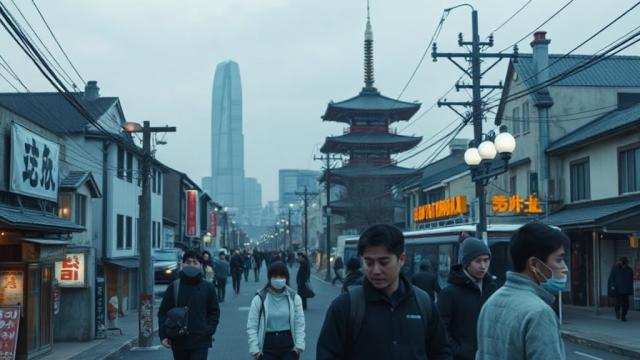
For over a decade, Japan has watched its population contract year after year, a quiet erosion that has reshaped communities, closed schools, and forced the closure of rural post offices and local businesses. Yet beneath this narrative of shrinkage, another story unfolds—one of vitality and transformation that defies the conventional image of an aging, insular nation. The numbers speak with unmistakable clarity: in more than 1,400 municipalities across the country, the total population fell while the number of foreign residents climbed, painting a portrait of a society in the midst of a profound demographic metamorphosis.
The Cities Leading the Transformation
When you examine where this growth concentrates, certain urban centers emerge as magnets for international residents seeking opportunity within Japan's borders. Osaka stands at the forefront of this movement, a city that has historically served as Japan's gateway to the world and now draws foreign residents at a pace that outstrips every other municipality in the nation. The port city welcomed an additional 25,056 foreign residents between January 2025 and January 2026, a figure that represents not merely a statistical increment but the arrival of an entire new neighborhood's worth of humanity into the urban fabric.
Following Osaka, the pattern of concentration reveals itself in Japan's other major economic hubs. Yokohama, Japan's second-largest city, added 11,056 foreign residents during the same period, while Nagoya contributed 10,091 to the national total. The ancient capital of Kyoto saw 6,483 new foreign residents, and Kawaguchi in Saitama Prefecture—often overshadowed by its more famous neighbor Saitama City—recorded 5,629 new international residents, a testament to how this phenomenon extends beyond the traditional centers of Tokyo, Osaka, and Nagoya.
Tokyo's Unique Position in the Data
You might find it curious that Tokyo does not dominate this ranking as one might expect from the nation's capital and largest metropolis. The explanation lies in how the Ministry of Internal Affairs and Communications tabulated its data: Tokyo Metropolis comprises numerous officially designated wards and cities, each counted as a separate municipality rather than as a unified entity. When you aggregate these component parts, the picture transforms dramatically.
Ten Tokyo wards and cities individually ranked among the top 100 municipalities for foreign population growth, with a combined increase of 22,118 foreign residents. Edogawa Ward led Tokyo's contingent with 4,839 new residents, followed by Shinjuku Ward with 3,260, Katsushika Ward with 2,877, and Nakano Ward with 2,513. Had these figures been pooled into a single metropolitan total, Tokyo would have claimed second place on the national ranking—perhaps even first, depending on how precisely one aggregates the data.
When Immigration Outpaces Emigration
The most striking dimension of this demographic shift emerges when you compare foreign population growth against Japanese population decline within the same municipalities. In all ten of the top-ranked cities for foreign resident growth, the Japanese population decreased during the measurement period. Yet in six of these municipalities, the influx of foreign residents actually exceeded the exodus of Japanese residents, resulting in a net population gain—a phenomenon that challenges the prevailing narrative of unremitting demographic decline.
Osaka exemplifies this dynamic most vividly: the city recorded 19,865 more new foreign residents than the number of Japanese residents lost, representing a net positive transformation of the city's demographic composition. Nagoya saw 7,717 more foreign arrivals than Japanese departures, while Tokyo's Edogawa Ward experienced 4,844 more foreign residents than Japanese residents lost. These figures suggest that for these urban centers, immigration has become not merely a demographic supplement but an actual counterweight to population shrinkage.
Understanding the Drivers Behind the Numbers
You should recognize that these increases do not represent immigration alone. The tallies also capture foreign residents already living in Japan who relocated to different municipalities, as well as children born to foreign residents within Japanese borders—a demographic factor that exists because Japan does not grant citizenship based on birth alone. However, when you consider the broader pattern, these factors alone cannot explain the magnitude of growth observed across multiple cities simultaneously.
If the increases resulted primarily from internal redistribution, you would expect to see corresponding decreases in the areas from which these residents relocated. The simultaneous growth across Japan's major population centers suggests something more fundamental: genuine immigration-driven expansion of the foreign resident population. The scale of these increases also exceeds what could plausibly result from births alone, reinforcing the conclusion that increased immigration has become a significant factor in Japan's evolving demographic landscape.
This transformation unfolds quietly, measured in ministry reports and statistical tables, yet its implications ripple through neighborhoods, school enrollment figures, local businesses, and the social fabric of communities across the nation. Japan continues to navigate an unprecedented experiment in demographic adaptation, one that may fundamentally reshape what it means to live in, work in, and belong to this island nation.
Reactions
Share
Related articles


0 Comments
You must log in to leave a comment
Be the first to share your thoughts on this article.
No comments yet
Be the first to share your thoughts on this article.